THE DECISION IN BRIEF
Our supplier sent a materials list and a dimension drawing; is that enough to approve an oil sprayer?
Use them to identify the candidate and its open questions. Obtain the actual bottle interface specification and a component-level contact review, then approve performance using assembled samples.
A drawing and a materials list answer different questions
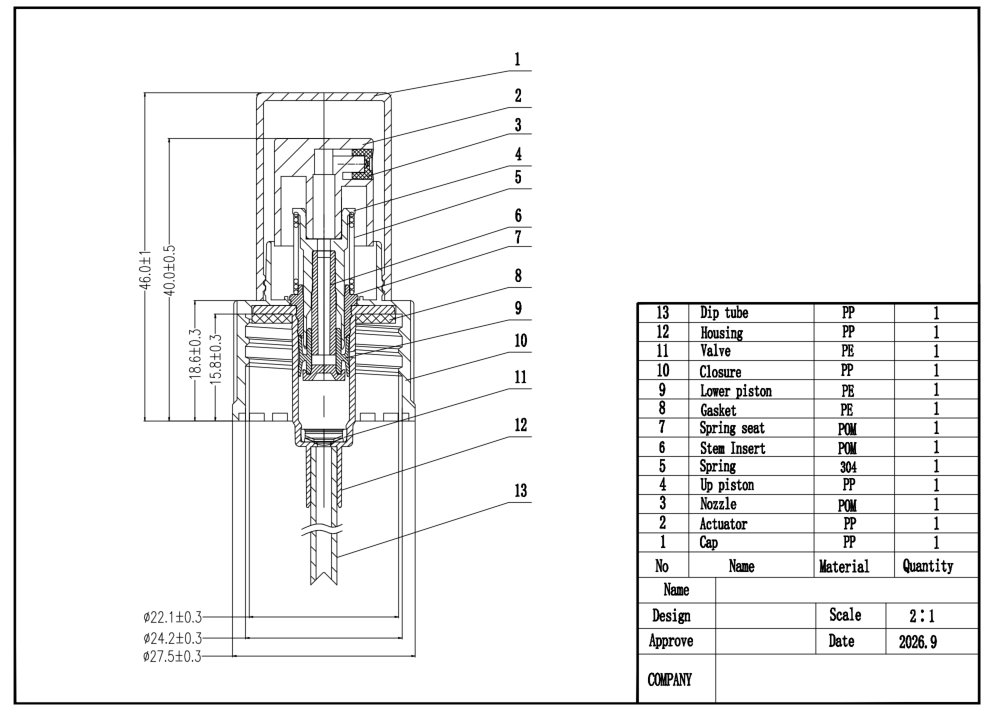
A general dimension drawing helps a buyer understand package proportions and discuss handling or carton space. A bill of materials describes construction. Neither document alone establishes that the proposed sprayer will fit a bottle, resist a finished formula or produce the intended spray. Start the review by identifying what each document actually covers and which revision is being quoted.
Write down the assembly reference attached to the documents. A supplier may offer several closures or internal variants under a product family name, so a drawing that resembles the sample is insufficient. Ask which details are fixed for the proposed order and which will be selected after technical evaluation. Keep unresolved fields visible in the purchasing record.
Read SP-LP-200 facts at their stated scope
STDPAK SP-LP-200 has confirmed PP, PE and POM components, a 304 stainless steel spring and a PP tube. Its double-layer seal is confirmed. This list does not identify an FKM or NBR seal, prove resistance to every oil, or establish any application-specific compliance. Request clarification when a contact component's material or function is not identified.
Ask the supplier to distinguish components exposed during normal dispensing from those that may contact liquid in storage or an unusual orientation. Use an annotated assembly drawing where available. The objective is a shared understanding of the contact path, not a guessed cross-section created from external photographs.
Resolve the bottle interface explicitly
Body diameters on the SP-LP-200 drawing are not bottle neck sizes. Do not use them to choose a nominal closure. Request the proposed closure specification and compare it with the bottle supplier's finish drawing. Include the sealing surface and tube arrangement in the review, then assemble physical samples.
Published trigger-sprayer specifications illustrate why an interface needs its own field: Silgan's Vela page separately lists closure choices and output. Those are characteristics of Vela, not values that can be transferred to an unidentified STDPAK assembly. Keep SP-LP-200 thread and output fields unconfirmed until the supplier supplies the corresponding information.
Use a document-gap checklist
Return a concise marked-up review rather than asking whether the model is generally suitable. This makes the next supplier response actionable.
- Identify the drawing revision, product reference and exact configuration attached to the quotation.
- Confirm the bottle finish from the bottle drawing; do not substitute a sprayer body dimension.
- Ask which listed and unlisted components contact the formula, including the sealing arrangement.
- Request the proposed tube measurement convention and the assembled sample's tube reference.
- Confirm intended output and spray behavior through supplier information and a formula trial.
- Attach any application-specific documentation requests to the exact configuration rather than the product family.
Turn clarified documents into a controlled sample
After the gaps are closed, order samples identified to the reviewed configuration. Check that their visible construction and bottle fit match the proposal. Evaluate the actual formula and retain an approved reference. Record any discrepancy before purchasing issues a production order.
If the supplier proposes a later component change, compare it with this record and decide what needs reevaluation. The useful outcome is not a long file of drawings; it is a reproducible specification linking a particular sprayer, bottle and formula to the evidence used for approval.
Sources & further reading
Use the references below alongside the selected component drawing and agreed sample plan. Product-specific claims need product-specific evidence.
PRODUCT REFERENCES
Components to discuss with your supplier.
These references share the component type discussed here. Confirm the selected assembly and application with samples.
Related articles
VIEW THE COMPONENTS