
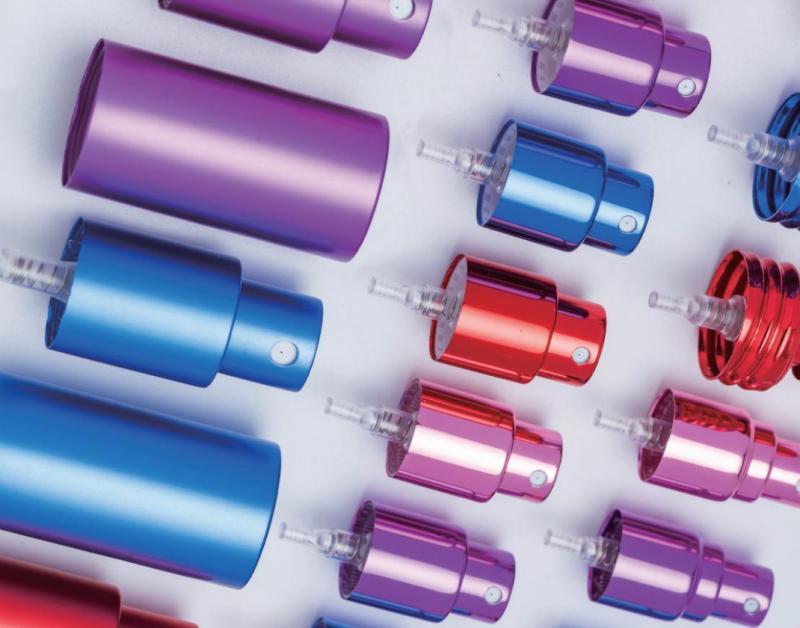
A luxury skincare mist is more than packaging; it’s a sensory bridge between product and consumer. Ultra-fine atomization creates a cloud-like application that reads as premium on-skin and on-shelf. Sourcing the right sprayer therefore requires balancing aesthetics with engineering: consistent dosage, chemical compatibility with actives and oils, finish options, supply reliability, and sustainability.
How we ranked manufacturers: emphasis on R&D and tooling capability, successful brand partnerships, quality control and testing, custom finishes, and measurable sustainability initiatives.
Navigation Menu
Aptar | Silgan | STDPAK | Albéa | Guala | Rieke | Yoshino | Mitani | Berry | Raepak
The Top 10 Manufacturers — expanded profiles
AptarGroup (USA / France)
Company snapshot: multinational leader with decades in consumer dispensing and a large R&D organization that serves beauty, pharma, and home care. Facilities in North America, Europe and Asia ensure regional qualification and multi-site redundancy.

What they offer: multiple Fine Mist and continuous atomizer platforms, advanced nozzle geometries, validated global tooling standards, and integrated finishing services (plating, lacquers, soft-touch). They publish spray-characterization data and often supply pilot tooling for brand testing.
Engineering strengths: fine droplet control, low-spit actuators, tight stroke-to-stroke dosing tolerances, and cross-validated chemical-compatibility libraries.
Sustainability & scale: active PCR programs and corporate targets for recycled-content adoption; large volumes reduce per-unit tooling amortization.
Procurement tip: request published D50/D90 droplet-size data and a region-specific supply continuity plan; expect MOQ and tooling amortization reflective of global brand service.
Silgan Dispensing Systems (USA)
Company snapshot: engineering-led supplier with a broad SKU catalog and deep assembly automation. Strong North American footprint with export capability.

What they offer: robust, proven actuators (e.g., Mark-series families), a wide viscosity range, and rapid tooling for mid-volume runs. Good documentation and standard part acceptance testing.
Engineering strengths: durable actuation mechanics that minimize “fade” over long runs and predictable force profiles for consistent consumer experience.
Commercial profile: predictable pricing tiers, clear sampling programs, and established QC protocols (incoming/outgoing inspection).
Procurement tip: use their catalog to identify a near-fit SKU, then request force-profile and life-cycle test data to avoid surprises in production.
STDPAK (China)
Company snapshot: positions itself as a premium sprayer specialist that combines high-end finishes with agile Asian manufacturing. Strong export focus for beauty brands targeting Europe and North America.

What they offer: invisible dip-tube aesthetics, leak-proof 18/410 & 20/410 designs built for e-commerce, rapid 3D prototyping and soft-tooling, and metallic finishes (gold, rose, matte black) tuned for luxe shelf impact.
Engineering strengths: short lead times on prototypes, competitive unit pricing at scale, and customization of neck finishes and collar geometries to match bottles.
Risk & mitigation: confirm export certifications (REACH, RoHS where relevant) and request independent ISTA drop-test reports; maintain a local QA contact for first production runs.
Procurement tip: leverage their rapid-proto capability for a pre-tooling pilot; negotiate staged MOQs and tooling amortization tied to confirmed reorder volumes.
Albéa (France)
Company snapshot: beauty-focused packaging house with full-system thinking — caps, closures, and pump assemblies designed to work as a coordinated aesthetic unit.

What they offer: integrated pump-and-cap assemblies, specialized perfume and cosmetic closures, design studio support for shelf presence, and lightweighting options to maintain perceived luxury without excess weight.
Engineering strengths: high-fidelity finishing, visual alignment across product families, and industrialized cosmetic assembly lines that preserve decorative quality at scale.
Procurement tip: ask for coordinated color-matching across finish runs and a mock-up of the complete cap/pump/bottle stack to validate shelf visuals before tooling approval.
Guala Closures Group (Italy)
Company snapshot: well-known European closure house with strong decorative finishing and high-output manufacturing lines, serving beauty and premium consumer goods.

What they offer: metallization, hot-stamping, and decorative inserts plus robust trigger sprayers for larger-volume body and home-care lines. Capability to integrate brand-safe anti-counterfeit or tamper features.
Engineering strengths: high throughput with consistent decorative results, and expertise in decorative coatings that resist rubbing and sweat.
Procurement tip: if you require decorative metal-look finishes at volume, run a surface-durability matrix (abrasion, salt-sweat, UVI) during prototyping.
Rieke (USA)
Company snapshot: specialist in chemically robust dispensing solutions with roots in industrial and commodity chemistry applications.

What they offer: actuators and valves compatible with acids, solvents, peptides and oil-heavy formulas; validated elastomer options (Viton, PTFE-lined seals) and accelerated-aging compatibility testing.
Engineering strengths: material selection tied to formula stability, contamination-minimizing designs, and strong documentation for regulatory needs.
Procurement tip: request a materials compatibility matrix and provide a 100–500 mL formula sample for vendor-run compatibility and accelerated stability tests.
Yoshino (Japan)
Company snapshot: precision-driven manufacturer known for meticulous QC and premium actuation feel. Strong reputation in Asian premium beauty lines.
What they offer: finely tuned actuation force, low-spit nozzles, and hand-feel engineering that improves perceived luxury during first-touch. Low defect rates from tightly controlled assembly processes.
Engineering strengths: customization of actuation force and return characteristics, and high-fidelity finishing that holds up under repeated use.
Procurement tip: ask for force-profile tuning during sample runs and confirm per-shift defect metrics for the chosen production cell.
Mitani Valve (Japan)
Company snapshot: valve specialist with medical and industrial heritage; expertise translates to micro-valves and ultra-fine atomization for facial mists.

What they offer: micro-valve geometries, clean-room assembly options, and laboratory characterization (particle-size distribution, spatter rates) suitable for hybrid med-beauty claims.
Engineering strengths: tight droplet-size control (D50 focus), low-volume dosing precision, and the ability to run validation testing to medical standards when required.
Procurement tip: if your brief calls for “medical-grade” droplet distributions, specify required D50/D90 targets and request lab-run spray maps with your formula.
Berry Global (USA)
Company snapshot: a giant in molded components and packaging, with strong sustainability commitments and resin-sourcing programs for PCR content.

What they offer: injection-molded sprayer bodies and sub-assemblies at very large volumes, in-house color and finish matching, and access to PCR supply contracts that stabilize recycled-content sourcing.
Engineering strengths: scale economics, robust supply-chain management, and offerings that support higher recycled content without immediate performance loss.
Procurement tip: establish PCR content guarantees and long-term resin pricing clauses to avoid sudden supply-driven mix changes that alter finish or mechanical feel.
Raepak (UK)
Company snapshot: design-forward boutique supplier that targets indie and D2C beauty brands with low MOQs and creative finishes.
What they offer: metal-free pump engines, short-run plating and soft-touch options, and flexible MOQ structures designed for trend-driven brands.
Engineering strengths: quick-turn design iterations, small-batch quality focus, and collaboration on brand-specific tactile finishes.
Procurement tip: ideal for limited-edition runs—negotiate sample pricing and short pilot runs to prove retail demand before committing to larger tooling spend.
Strategic buying checklist — what to confirm before placing tooling or production orders
Dosage & consistency
Ask: “What is your measured stroke-to-stroke variance (g or µL) at production scale?”
Expect: Data from validation runs; tolerance bands (e.g., ±0.01g for high-precision mists).
Chemical compatibility & materials
Ask: “Which elastomers and plastics do you recommend (NBR, Viton, PTFE) for our formula? Can you provide compatibility test reports?”
Expect: Material certificates, accelerated-aging data, and sample compatibility testing.
Atomization & spatter performance
Ask: “Can you provide particle size distribution (D50/D90) and spitting incidence for this actuator with our formula?”
Expect: Laboratory spray-characterization reports (droplet size, plume shape).
Customization & finishes
Ask: “Lead times for custom tooling, minimum order quantities (MOQs), and available plating/soft-touch/metal-look finishes?”
Expect: Tooling timelines, prototype options (3D/soft tooling), and MOQ thresholds.
Packaging robustness (especially for e-commerce)
Ask: “What drop/vibration testing do you perform and what anti-leak features are standard?”
Expect: Test reports (ISTA or equivalent) and recommended closure/liner options.
Sustainability & recyclability
Ask: “What % PCR or bio-based content is possible without compromising finish/feel? Do you offer take-back or PCR supply assurances?”
Expect: PCR content specs, third-party verification, and supply continuity plans.
Quality systems & traceability
Ask: “Do you provide ISO/QC certificates, batch traceability, and incoming/outgoing inspection protocols?”
Expect: ISO certifications, inspection sampling plans, and recall traceability capabilities.
Pricing & lead time transparency
Ask: “What are tiered pricing breaks, tooling amortization schedules, and realistic lead times for first and repeat orders?”
Expect: Clear pricing schedule with sample/PPAP costs, and realistic lead-time estimates.
Regulatory & documentation support
Ask: “Can you provide SDS-compliant materials info and help with regulatory filing where relevant?”
Expect: Material declarations and documentation support for regional compliance.
Practical next steps for procurement teams
Shortlist 3 suppliers that match your priorities (e.g., finish + atomization + PCR).
Send a technical brief and 100–500 mL sample of your formula for compatibility and spray characterization.
Request prototype lead times and sample costs; run an ISTA drop test on packaged sample.
Compare full landed cost (tooling amortized, freight, duty, inspection) rather than unit price alone.
Lock in material and PCR guarantees in the contract to avoid downstream brand risk.
Final takeaway
For luxury skincare mists, the sprayer is a functional brand touchpoint: the wrong actuator can undermine expensive formulas and marketing. Prioritize consistent atomization and material compatibility first; aesthetic finishes and sustainability follow, but only after engineering performance is validated.